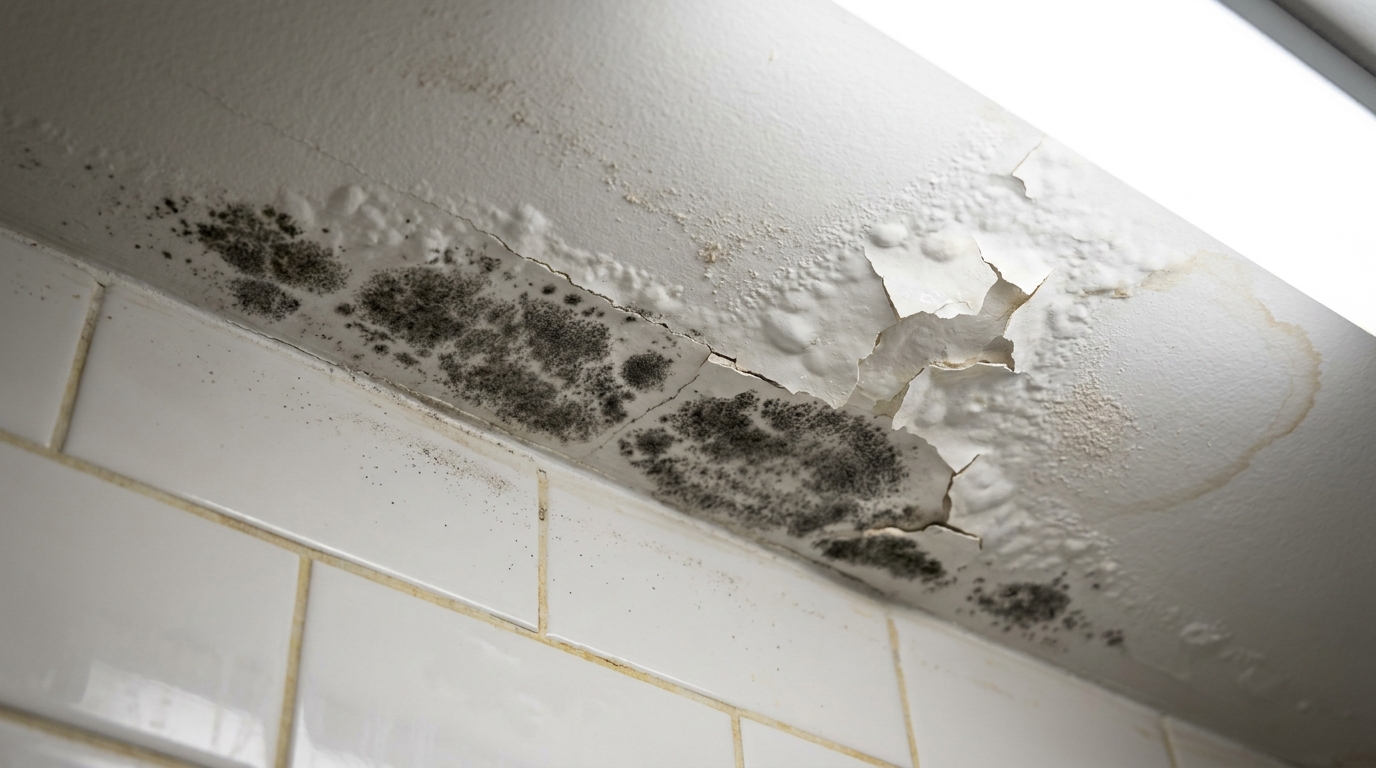
You reported a dark, spreading stain on the bathroom ceiling. Your landlord took a quick look and said, “That’s not mold. It’s just dirt.” Now you are left wondering whether to trust that assessment or push back. When a landlord says it’s not mold, tenants deserve more than a verbal dismissal. They deserve facts, a clear process for verification, and an understanding of their legal rights.
This guide walks through how to identify mold, distinguish it from common look-alikes, document the problem, and protect yourself if your landlord refuses to act.
What Does Mold Actually Look Like? (And What Gets Mistaken for It)
Mold appears in many colors and textures, and it rarely looks like the dramatic black patches shown on television. According to Howard Environmental, common indoor molds can appear black, dark green, white, orange, yellow, or even pink, with textures ranging from fuzzy and powdery to flat and slimy. Growth often starts as small speckles that spread and merge over time.
Texture and surface damage provide important clues. Trauma Services notes that active mold may feel wet and slimy, while sporulating mold can be dry and powdery. If the growth smears when rubbed and the material underneath feels soft or weakened, that strongly suggests mold rather than surface grime.
Smell matters too. A persistent musty or earthy odor, especially near bathrooms, basements, or under sinks, is a classic indicator of hidden mold even when nothing is visible.
So what gets mistaken for mold? Several things:
| Substance | Appearance | Key Difference from Mold |
|---|---|---|
| Dust or soot | Gray or black smudges near vents or candles | Brushes off dry without smearing; no moisture source nearby |
| Efflorescence | White powdery deposit on concrete or brick | Dissolves in water; no musty smell; masonry stays hard underneath |
| Mildew | Flat white or gray film on tile or shower curtains | Often surface-level; still a fungal growth requiring cleanup |
| Old water stains | Brown or yellow rings on ceilings or walls | No fuzzy texture or odor unless active mold has colonized the stain |
According to OSHA, color alone cannot identify mold type. Many dark molds are harmless, and some harmful species are not black at all. Only laboratory analysis can determine species.
The bottom line: if a suspicious patch is growing in a damp area, smells musty, or smears when touched, treat it as a mold problem until proven otherwise.
Why Do Landlords Deny Mold Problems?
Landlords dismiss mold complaints for financial, legal, and practical reasons, and understanding those motivations helps tenants respond effectively.
Cost avoidance is the primary driver. Professional mold remediation can run $500 to $6,000 or more depending on the scope, according to industry cost surveys. The EPA recommends professional remediation for mold areas larger than about 10 square feet, which often means opening walls, removing porous materials, and temporarily relocating tenants. Many landlords would rather call it “dirt” than face that expense.
Legal liability is a close second. According to Nolo, landlords in nearly every state carry an implied warranty of habitability that requires them to maintain safe, sanitary housing. Acknowledging mold caused by a building defect like a leaking roof or broken pipe can trigger liability for medical costs, property damage, and rent abatements. FindLaw notes that tenants can sue for health problems and property damage, often in small claims court.
Blame-shifting is common. Some landlords attribute mold to tenant behavior, claiming poor ventilation or excessive moisture from cooking and showering. While tenants do share responsibility for basic humidity control, structural moisture problems like roof leaks, foundation seepage, and plumbing failures fall squarely on the landlord.
The “bleach and paint” shortcut. Rather than proper remediation, some landlords wipe the surface with bleach and paint over it. The EPA specifically warns against this approach on porous materials like drywall, noting that mold can remain inside the material and regrow quickly if moisture persists.
How Can You Tell If It Really Is Mold?
Several practical tests and observations can help distinguish mold from harmless staining, even without a laboratory.
The EPA states that if you can see mold or smell mold, a health risk may be present, and you do not need to identify the specific species to take action. Visible growth combined with a moisture source is enough to justify cleanup.
The bleach spot test. According to Family Handyman, mixing one part bleach with 16 parts water and dabbing it on the suspect spot with a cotton swab can provide a quick indicator. If the spot lightens within a minute or two, it is likely mold or mildew. If it stays dark and wipes off cleanly without returning, it is more likely dirt.
Measure humidity. Harvard Health Publishing recommends keeping indoor relative humidity between 30% and 50%. A $10 to $20 hygrometer from any hardware store can tell you whether your unit consistently exceeds 60%, which creates conditions favorable to mold growth.
Check moisture in building materials. Family Handyman notes that moisture readings above 20% in walls or ceilings “definitely mean you have a problem” and strongly suggest conditions for mold and rot. Inexpensive pin-type moisture meters are available for under $30.
Probe for structural damage. Press a screwdriver gently into suspect baseboards, window trim, or subfloor. If the wood is soft or crumbles, fungal decay is likely present beneath the surface.
For a more thorough approach, a home mold test kit can provide laboratory confirmation of whether mold spores are present at elevated levels.
What Are the Signs Your Body Is Reacting to Mold?
Persistent allergy-like symptoms that improve when you leave your rental unit are one of the strongest clues that indoor mold is affecting your health.
According to the Mayo Clinic, common mold allergy symptoms include sneezing, runny or stuffy nose, cough, postnasal drip, itchy or watery eyes, and dry or itchy skin. These overlap heavily with seasonal allergies, which is why many people do not immediately connect their symptoms to their living environment.
The numbers are significant. According to Thermo Fisher Scientific, mold sensitization affects an estimated 3% to 10% of the general population but may reach as high as 80% in people with asthma. The EPA notes that mold can trigger asthma episodes in sensitive individuals and that people with asthma should avoid exposure.
A critical self-test: track whether your symptoms improve when you spend extended time away from the unit, such as during a weekend trip or a stay at a friend’s home. According to both the Mayo Clinic and the EPA, symptom improvement away from a damp or moldy environment is a meaningful clinical clue.
Any tenant experiencing persistent respiratory symptoms in a rental with visible moisture damage or musty odors should consult a physician. A doctor can evaluate whether mold exposure may be contributing to symptoms and provide medical documentation that strengthens a habitability complaint.
How to Document Mold When Your Landlord Won’t Acknowledge It
Strong documentation is the foundation of any successful tenant complaint, whether filed with a landlord, code enforcement, or a court.
The EPA recommends documenting moisture and mold with photographs and written descriptions as part of any moisture control plan. Here is a practical framework tenants can follow:
1. Photograph everything, repeatedly. Take close-up and wide-angle photos of the suspected mold, any water stains, leaks, or peeling paint, and the surrounding area for context. Use your phone’s timestamp feature. Return to the same spots every few days or weekly and photograph again to show whether the growth is spreading.
2. Keep a written mold log. Record dates, locations, descriptions of visible growth, odors, and any health symptoms. Note whether symptoms improve when you leave the unit. According to LookMold, a mold log should include revisits to problem areas every few days to document changes over time.
3. Save all communication. Every request to the landlord should be in writing, whether by email, text, or certified letter. Keep copies of all notices, responses, maintenance requests, and work orders. If the landlord makes verbal promises, follow up with an email summarizing what was said.
4. Record humidity and moisture readings. If you purchase a hygrometer or moisture meter, log the readings with dates and locations. Readings consistently above 60% relative humidity or above 20% moisture in building materials provide objective evidence that contradicts a “just dirt” dismissal.
5. Get a professional inspection when possible. According to Angi, a professional mold inspection typically costs $300 to $1,000. A certified mold inspector’s written report with moisture readings and photographs is one of the strongest pieces of third-party evidence a tenant can present.
What Are Your Rights as a Tenant When Mold Is Denied?
Tenants in nearly every state have legal protections when a landlord fails to address conditions that threaten health and safety.
According to Nolo, all states except Arkansas impose some form of implied warranty of habitability on residential landlords. This generally requires landlords to provide safe, sanitary housing and to fix serious conditions affecting health. Significant mold growth caused by building defects typically falls under this obligation, even when “mold” is not explicitly named in the statute.
Some jurisdictions go further. New York City, for example, classifies indoor mold growth over 10 square feet as a hazardous violation under the Housing Maintenance Code, requiring landlords to remediate. California’s Toxic Mold Protection Act of 2001 (Health & Safety Code §§26100-26156) directs the state to develop mold assessment and remediation standards and requires disclosure of material defects including significant mold.
Tenants generally have several options when a landlord refuses to act:
- File a complaint with local housing or code enforcement. Many cities and counties have inspection programs that can cite landlords for habitability violations.
- Request a rent abatement or repair-and-deduct remedy. Some states allow tenants to deduct repair costs from rent or withhold rent entirely when serious habitability issues go unaddressed. Strict procedural rules apply, so consult a local attorney first.
- Sue for damages. FindLaw notes that tenants can pursue claims for medical costs, lost property, and other damages, often in small claims court.
- Contact a tenant-rights organization. Local legal aid offices and tenant unions can provide free or low-cost guidance on mold laws specific to your state.
Anti-retaliation protections exist in most states. A landlord cannot legally raise rent, reduce services, or begin eviction proceedings in response to a legitimate habitability complaint.
How Can You Reduce Mold Risk in a Rental?
Tenants can take meaningful steps to reduce mold risk even while waiting for a landlord to address structural issues.
According to the EPA, indoor relative humidity should stay below 60% and ideally between 30% and 50%. Running exhaust fans during and after showers, opening windows when weather permits, and using a portable dehumidifier in damp rooms all help. The CDC recommends keeping humidity at or below 50% and drying any wet surfaces or spills within 24 to 48 hours.
Understanding what mold needs to grow helps tenants identify and address risk factors early. Key prevention steps include:
- Run bathroom and kitchen exhaust fans during and for 15 to 20 minutes after moisture-generating activities. Verify that fans vent to the outside, not just into the attic.
- Wipe down shower walls and windowsills where condensation collects.
- Move furniture slightly away from exterior walls to allow air circulation and prevent trapped moisture.
- Report leaks immediately in writing, and follow up if repairs are delayed.
- Avoid drying clothes indoors without adequate ventilation, as this adds significant moisture to the air.
The Connecticut Department of Public Health recommends that landlords conduct moisture inspections annually and between tenancies. If your landlord does not perform routine inspections, your own humidity readings and leak reports create a paper trail showing you took reasonable steps.
When Should You Get a Professional Mold Inspection?
A professional inspection is warranted whenever mold is suspected but not visible, when growth exceeds a small patch, or when a landlord disputes the problem.
The EPA states that mold can begin growing within 24 to 48 hours on wet materials. If your unit experienced flooding, a roof leak, or a plumbing failure that was not fully dried within that window, a professional inspection is strongly recommended.
Other situations that call for professional assessment:
- Persistent musty odor with no visible source. Mold may be growing inside wall cavities, under flooring, or in HVAC ductwork where only a professional with moisture meters and borescopes can find it.
- Visible growth larger than about 10 square feet. The EPA suggests consulting professional remediators for areas exceeding this threshold.
- Recurring mold after cleaning. Mold that returns after surface cleaning almost always indicates an unresolved moisture problem that requires investigation.
- Health symptoms that correlate with time spent in the unit. When occupants experience respiratory or allergy symptoms that improve away from home, a professional assessment can identify whether the indoor environment is the cause.
- Landlord disputes. A certified inspector’s written report carries far more weight than a tenant’s photos alone in code enforcement complaints, mediation, or court.
According to Angi, professional mold inspections typically cost $300 to $1,000 depending on home size and complexity. Harvard Health Publishing recommends using professionals certified by organizations such as the Institute of Inspection, Cleaning and Restoration Certification (IICRC) or the National Environmental Health Association.
The EPA does not license or certify mold inspectors at the federal level, but some states require licensing. Ask any prospective inspector about their certifications, training, and experience before hiring.
If you need help locating a qualified mold professional in your area, visit our find a contractor page to connect with vetted local specialists.
Disclaimer: This article provides general information for educational purposes. It does not constitute legal or medical advice. Tenants with health concerns should consult a physician. Those facing legal disputes should consult a licensed attorney familiar with tenant-rights law in their jurisdiction. MoldGuide may receive referral compensation from service providers listed on this site.